American Kestrel
Listen to the American Kestrel
Scientific name: Falco sparverius
Family: Falconidae (Falcons and Caracaras)
By Les Miller
The American Kestrel has a distinctive, high-pitched call often described as killy-killy-killy or klee-klee-klee. This rapid series of sharp notes can help you locate a kestrel perched on a utility wire, hunting over a field, or flying overhead.
Kestrels also produce softer whining and chittering sounds during courtship, nesting, and interactions with other birds.
Scientific Name: Falco sparverius
Family: Falconidae (Falcons)
About the American Kestrel
The American Kestrel is North America's smallest falcon and one of its most colorful birds of prey. Although only about the size of a Mourning Dove, this agile hunter has sharp talons, excellent eyesight, and remarkable flying abilities.
In Wisconsin, American Kestrels are most often seen in open countryside, grasslands, agricultural fields, and along roadsides. They frequently perch on utility wires or fence posts while searching for insects, small mammals, and other prey. Their ability to hover briefly while hunting makes them especially fascinating to watch.
Identification and Appearance
The American Kestrel is a small, slender falcon measuring approximately 8–12 inches long, with a wingspan of 20–24 inches. Its pointed wings, long tail, and distinctive facial markings make it relatively easy to recognize.
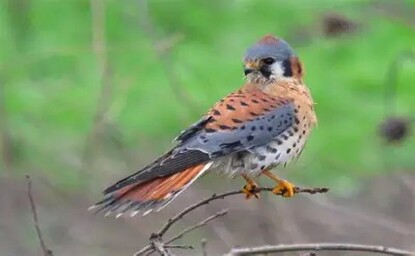
Male American Kestrels have blue-gray wings, a rusty-red back and tail, and a pale underside marked with dark spots. Females are more uniformly reddish-brown, with dark barring across their wings, backs, and tails. Both sexes have two bold, dark vertical markings on each side of the face.
In flight, kestrels beat their wings quickly and occasionally hover in place while searching the ground for prey. Their long, narrow wings and graceful movements distinguish them from many other small birds of prey.
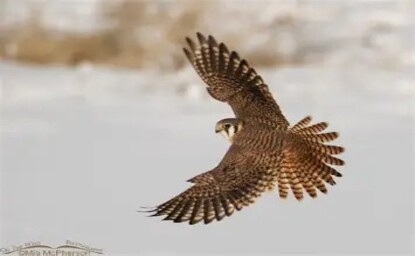
Female American Kestrel in Flight
Diet and Hunting Behavior
American Kestrels are skilled hunters that feed primarily on large insects and small animals. During Wisconsin's warmer months, grasshoppers, crickets, beetles, and dragonflies make up an important part of their diet. They also capture mice, voles, small birds, and occasionally lizards or other small prey.
Kestrels often hunt from utility wires, fence posts, or exposed branches, watching the ground for movement before swooping down. They can also hover almost motionless in the air by rapidly beating their wings and adjusting their tails while searching for prey below.
Their hunting habits change with the seasons. During summer, insects are plentiful, while colder weather may lead kestrels to rely more heavily on small mammals and birds.
Nesting and Family Life
s
American Kestrels are cavity nesters and use holes in dead trees, abandoned woodpecker cavities, and specially designed nest boxes. Unlike many songbirds, they do not build nests from twigs or grasses. Instead, females lay their eggs directly on the floor of a suitable cavity, often in a shallow depression.
In Wisconsin, kestrels generally begin nesting in spring. A typical clutch contains four or five eggs, which hatch after approximately 26–32 days of incubation. Both parents help care for the young, with the male often bringing food while the female spends more time attending the eggs and newly hatched chicks.
Young kestrels usually leave the nest about four weeks after hatching but continue depending on their parents for food while developing their hunting skills. Suitable nesting cavities and open hunting habitat are essential for successful breeding.
Migration and Seasonal Presence in Wisconsin
American Kestrels are found throughout Wisconsin during the breeding season, with many returning to northern areas in March and April. Spring brings increased activity as kestrels establish territories, select nesting cavities, and begin raising their young.
During September and October, many Wisconsin kestrels migrate south as colder weather reduces the availability of insects and other prey. Most travel relatively short distances to areas where food remains available throughout winter.
Not all American Kestrels leave Wisconsin. Some remain year-round, particularly in southern parts of the state, where open fields and agricultural landscapes provide opportunities to hunt small mammals and birds. Winter sightings become less frequent farther north.
Conservation and Population Challenges
Although American Kestrels remain widespread across North America, their populations have declined significantly over recent decades. Scientists are investigating possible causes, including grassland loss, fewer suitable nesting cavities, changes in agricultural practices, and reduced availability of insect prey.
In Wisconsin, conservation organizations are working to protect kestrels by installing and monitoring specially designed nest boxes. These boxes provide nesting opportunities where natural tree cavities are scarce. Volunteers also monitor nesting success and band young birds to help researchers better understand kestrel populations and movements.
Wisconsin birders can help by supporting grassland conservation, protecting suitable dead trees where safe, reducing unnecessary pesticide use, and participating in organized kestrel monitoring projects. Protecting both open hunting habitats and nesting sites is important for the future of this colorful little falcon.
Interesting Facts About the American Kestrel
The American Kestrel may be North America's smallest falcon, but it has some remarkable abilities and behaviors.
• An expert at hovering: Kestrels can remain nearly stationary in the air while watching the ground for prey, using rapid wingbeats and careful adjustments of their long tails.
• Males and females look different: Unlike many birds of prey, male and female kestrels have noticeably different plumage. Males display blue-gray wings, while females have reddish-brown wings with dark barring.
• A hunter with ultraviolet vision: American Kestrels can detect ultraviolet light, which may help them locate small mammals by revealing traces such as urine markings.
• A falcon that uses nest boxes: Because kestrels nest in cavities rather than building traditional nests, appropriately placed nest boxes can provide valuable breeding sites.
• Small but surprisingly fierce: Despite their size, kestrels are capable predators that capture insects, small mammals, and occasionally birds nearly as large as themselves.
Final Thoughts
The American Kestrel is a remarkable little falcon that brings color, speed, and excitement to Wisconsin's open landscapes. Whether perched on a roadside wire, hovering above a grassy field, or hunting insects over a prairie, this bird offers fascinating opportunities for observation.
Its declining populations remind us of the importance of protecting grasslands and nesting habitats. By learning to recognize the American Kestrel and supporting conservation efforts, Wisconsin birders can help ensure that future generations continue to enjoy this beautiful bird of prey.