American Robin
Listen to the American Robin
Scientific name: Turdus migratorius
Family: Turdidae (Thrushes)
By Les Miller
Introduction/overview
The American Robin is one of Wisconsin's most familiar birds, recognized by its warm reddish-orange breast, gray-brown back, and cheerful spring song. Often seen hopping across lawns, parks, and gardens, this member of the thrush family is a welcome sight in neighborhoods and natural areas throughout the state.
Although many people associate robins with the arrival of spring, some remain in Wisconsin during winter, particularly where berries and other food sources are available.
American Robins inhabit a wide variety of environments, from forests and woodland edges to city parks and backyards. Their adaptability, distinctive appearance, and active behavior make them enjoyable birds to observe throughout the year.
HOW TO IDENTIFY AN AMERICAN ROBIN
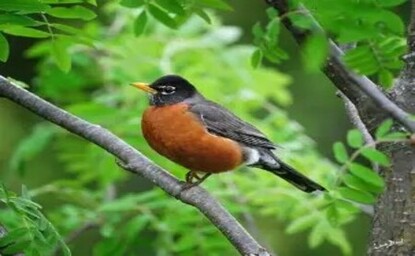
The American Robin is a medium-sized songbird measuring approximately 9–11 inches long. It has a rounded body, relatively long legs, and a straight, slender yellow bill.
Its most recognizable feature is its reddish-orange breast, which contrasts with a gray-brown back, darker head, and white markings around the eyes. The lower belly is white, and white patches beneath the tail are often visible when the bird moves or flies.
Male robins generally have darker heads and brighter breasts, while females tend to have slightly paler coloring. Young robins look different from adults, with spotted breasts that help camouflage them during their early weeks.
One of the easiest ways to recognize an American Robin is by its movement. Watch for a bird hopping across a lawn, stopping suddenly, tilting its head, and searching for earthworms or insects in the grass.
Its orange breast, upright posture, and familiar foraging behavior make the American Robin one of Wisconsin's easiest birds to identify.
SOUNDS AND BEHAVIOR
The American Robin is well known for its rich, musical song, often heard during spring and summer mornings. Its song consists of a series of clear, whistled phrases, sometimes described as a cheerful, repeated melody. Robins frequently sing from treetops, rooftops, and other elevated perches, especially around sunrise and sunset.
In addition to singing, American Robins use several calls, including a sharp tut-tut-tut alarm call and a softer, high-pitched seee sound when danger is nearby.
Robins are active ground foragers. They hop across lawns and open areas, pausing to inspect the ground before pulling earthworms or capturing insects. During fall and winter, they often gather in flocks and feed on berries in trees and shrubs.
Their familiar songs, upright posture, and characteristic hopping movements make American Robins enjoyable to watch and easy to recognize.
HABITAT AND DIET
Where It Lives
American Robins are found throughout Wisconsin in a wide variety of habitats. They are especially familiar in backyards, parks, gardens, woodland edges, and open areas with scattered trees.
Robins prefer places that offer open ground for feeding and nearby trees or shrubs for nesting and shelter. They also inhabit forests, orchards, and natural areas throughout the state.
What It Eats
American Robins eat earthworms, insects, spiders, and a variety of fruits and berries. During spring and summer, they frequently search lawns and grassy areas for worms and other invertebrates.
In fall and winter, fruits and berries become especially important. Robins may gather in large flocks to feed on crabapples, serviceberries, and other available fruit.
Their flexible diet helps them survive in Wisconsin's changing seasonal conditions.
WHEN AND WHERE TO FIND AMERICAN ROBINS IN WISCONSIN
American Robins are widespread throughout Wisconsin and can be found in cities, small towns, forests, parks, and rural landscapes. Although they are often associated with the arrival of spring, some remain in the state throughout winter.
Spring and Summer
Robins become especially noticeable in early spring as more birds return to Wisconsin and males begin singing to establish territories. Look for them hopping across lawns, searching for earthworms, or singing from treetops and rooftops.
During summer, robins are common in parks, gardens, wooded neighborhoods, and forest edges, where they raise their young and search for insects and other food.
Fall and Winter
In fall, robins often gather in flocks and shift their attention toward berries and other fruits. Many migrate south, but others remain in Wisconsin wherever suitable food and shelter are available.
During winter, check fruit-bearing trees and shrubs, sheltered woodlands, and areas with open water. Robins may be less noticeable because they spend less time feeding on lawns.
Where to Look
American Robins occur throughout Wisconsin, from northern forests to southern cities and farmland. Watch open grassy areas during warmer months and fruit-bearing trees during colder weather.
Their familiar appearance, musical songs, and adaptable behavior make them rewarding to observe year-round.
NESTING AND FAMILY LIFE
Building the Nest
American Robins build sturdy, cup-shaped nests using grasses, twigs, and other plant materials, often reinforcing the structure with mud. The inside is lined with fine grasses to provide a comfortable place for their eggs.
Robins commonly nest in trees and shrubs, but they may also choose sheltered locations on buildings, porch lights, or other human-made structures.
Eggs and Young
A typical robin clutch contains three to five eggs, famous for their beautiful pale blue color. The female incubates the eggs for approximately two weeks.
Both parents feed the nestlings, bringing earthworms, insects, and other small invertebrates. Young robins usually leave the nest about two weeks after hatching, although they continue receiving parental care afterward.
Raising a Family in Wisconsin
American Robins may raise two or three broods during a Wisconsin breeding season when conditions are favorable.
During spring and summer, watch for adults carrying nesting materials or delivering food to their young. Observe nesting birds from a respectful distance and avoid disturbing active nests.
Providing native trees, shrubs, and safe nesting habitat can help support robins and other backyard birds.