American Woodcock
Listen to the American Woodcock
Scientific Name: Scolopax minor
Family: Scolopacidae (Sandpipers and Allies)
By Les Miller
Introduction/overview
The American Woodcock is famous for its unusual nasal peent call, most often heard at dusk during the spring breeding season. Males repeat this distinctive sound from open grassy areas before launching into their spectacular courtship flights.
During these aerial displays, their wings produce musical twittering sounds as the birds spiral high into the sky. The combination of nasal calls and whistling wing sounds makes the American Woodcock's spring courtship performance one of Wisconsin's most memorable birding experiences.
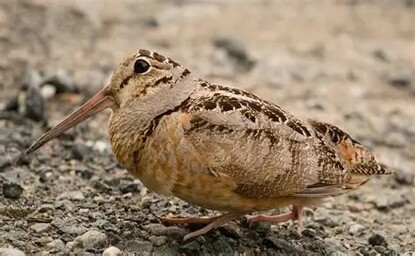
The American Woodcock is a secretive woodland bird known for its remarkable camouflage, unusually long bill, and entertaining spring courtship displays. Its mottled brown, black, and buff feathers blend almost perfectly with fallen leaves on the forest floor, making it difficult to spot even when nearby.
Although related to sandpipers, the American Woodcock prefers moist forests, brushy thickets, and young woodlands rather than open beaches. It spends much of its time probing soft soil for earthworms and other small invertebrates.
In Wisconsin, American Woodcocks are familiar spring and summer residents of suitable habitats. Their distinctive evening calls and aerial courtship displays make them especially rewarding birds to observe during the spring breeding season.
Identification and Appearance
The American Woodcock is a plump, short-legged bird measuring approximately 10–12 inches long, with a wingspan of 16–18 inches. Its rounded body, short neck, and unusually long, straight bill give it a distinctive appearance unlike most other Wisconsin woodland birds.
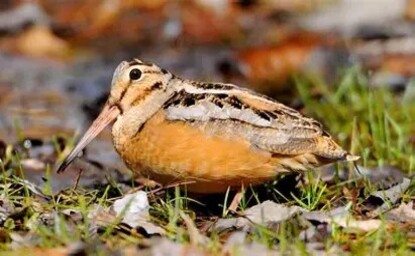
Its feathers are beautifully patterned in shades of brown, black, gray, and buff, providing excellent camouflage among fallen leaves and forest vegetation. Dark bands cross the top of its head, while its large eyes sit unusually high and far back on the skull, helping it detect danger while feeding.
Males and females look similar, although females are generally larger and have slightly longer bills. When flushed from the forest floor, an American Woodcock often bursts into flight with rapid wingbeats, maneuvering through trees and shrubs before dropping back into cover.
Habitat and Where to Look in Wisconsin
American Woodcocks prefer moist, young forests, brushy thickets, alder and willow stands, and woodland edges where soft soil provides abundant earthworms. In Wisconsin, they are often associated with regenerating forests, lowland hardwoods, and openings surrounded by dense vegetation.
During daylight hours, woodcocks usually remain hidden on the forest floor, where their mottled feathers blend into fallen leaves. They are difficult to spot, even at close range. At dusk during spring, males move to grassy openings, old fields, and forest clearings to perform their distinctive courtship displays.
One of the best ways to find an American Woodcock in Wisconsin is to visit a suitable clearing shortly after sunset in March or April. Stand quietly near the edge of the opening and listen for the male's repeated nasal calls before watching for his spiraling display flight. Keep a respectful distance and avoid disturbing birds in their feeding or nesting areas.
Diet and Feeding Behavior
Earthworms make up most of the American Woodcock's diet. These unusual woodland birds also eat insects, insect larvae, snails, and other small invertebrates found in moist soil. Their preference for soft, damp ground makes young forests, wet thickets, and woodland edges particularly valuable feeding habitats.
The woodcock's long bill is specially adapted for probing beneath the surface. Sensitive nerve endings near its tip help the bird detect prey hidden in the soil. Remarkably, the upper tip of the bill can flex slightly while the bill remains inserted in the ground, allowing the woodcock to grasp earthworms without fully withdrawing it.
While searching for food, American Woodcocks sometimes perform an unusual rocking walk, shifting their bodies back and forth as they move across the forest floor. Scientists have suggested this movement may help them locate prey, although its exact purpose remains uncertain.
Nesting and Family Life
American Woodcocks nest on the ground in young forests, brushy woodlands, and areas with dense understory. The female creates a shallow depression among fallen leaves, often beside a shrub or small tree. Her mottled brown plumage provides excellent camouflage while she sits on the nest.
A typical clutch contains four eggs, which the female incubates for approximately 20–22 days. Male woodcocks do not help incubate the eggs or raise the chicks; instead, they continue their courtship displays throughout the breeding season.
Woodcock chicks hatch covered in soft, patterned down and can leave the nest within hours. They begin probing for food at a young age, although their mother continues to guide and protect them. The chicks usually become capable of flight at around two weeks of age and gradually become independent as they develop their feeding skills.
In Wisconsin, nesting generally begins in early spring, sometimes while nighttime temperatures are still chilly. Young forests and protected woodland habitats provide important shelter for nesting females and their growing chicks.
Migration and Seasonal Presence in Wisconsin
American Woodcocks are migratory birds that return to Wisconsin early in spring, often arriving in mid-March as the ground begins to thaw. Their arrival is closely tied to soil conditions because they depend heavily on earthworms for food.
Spring is one of the best times to observe woodcocks in Wisconsin. From March through May, males perform their remarkable courtship displays at dusk and before dawn. Their repeated nasal calls and spiraling flights make them easier to locate during this season than at other times of the year.
During September and October, American Woodcocks begin moving south, with migration often continuing into November. Most spend the winter in the southeastern United States, including areas along the Gulf Coast and Mississippi River lowlands. Woodcocks are uncommon in Wisconsin during winter because frozen ground makes earthworms difficult to reach.
Conservation and Population Challenges
American Woodcock populations have declined across much of North America over recent decades, largely because of changes in forest habitats. As young forests mature and brushy openings disappear, woodcocks lose important areas for nesting, feeding, and raising their young. Development and habitat fragmentation can create additional challenges.
In Wisconsin, conservation efforts focus on maintaining a mixture of young forests, moist woodlands, alder thickets, and open areas used for courtship displays. Wildlife managers encourage young trees and shrubs to grow while protecting suitable feeding areas. These efforts also benefit other birds that depend on early-successional habitats.
Wisconsin birders can help by supporting responsible forest management, protecting wetlands and brushy habitats, and participating in bird-monitoring programs. Observing woodcocks from a respectful distance during their spring courtship displays helps protect these unusual birds while allowing others to enjoy one of Wisconsin's most fascinating wildlife experiences.
Interesting Facts About the American Woodcock
The American Woodcock is one of Wisconsin's most unusual woodland birds, with several fascinating adaptations and behaviors.
• Nearly all-around vision: Its large eyes are positioned high and far back on its head, giving the woodcock an exceptionally wide field of view while it searches the ground for food.
• The famous sky dance: During spring courtship, males launch into spiraling flights above grassy clearings. Their outer wing feathers produce musical twittering sounds, followed by a descending series of chirps as they return to the ground.
• A bird with many nicknames: American Woodcocks are sometimes called timberdoodles, bogsuckers, or mudbats because of their unusual appearance and habits.
• A remarkable bill: The flexible tip of the woodcock's upper bill helps it grasp earthworms while probing deep into soft soil.
• A distinctive rocking walk: Woodcocks sometimes bob and sway as they move across the forest floor, creating an amusing dance-like appearance. The exact purpose of this behavior is still being studied.
Final Thoughts
The American Woodcock is one of Wisconsin's most fascinating and easily overlooked birds. Its remarkable camouflage, unusual feeding habits, and spectacular spring courtship displays make it a rewarding species for birders of all experience levels.
Although woodcocks spend much of their time hidden in dense woodland vegetation, their evening sky dances offer a wonderful opportunity to experience something truly special. A quiet visit to a grassy clearing on a mild spring evening may reveal their distinctive nasal calls, musical wing sounds, and remarkable aerial performances.
Whether you're exploring Wisconsin's young forests, walking woodland trails, or listening for birds at sunset, the American Woodcock reminds us that some of nature's most memorable discoveries happen when we slow down, listen carefully, and pay attention to the world around us.