Black-capped Chickadee
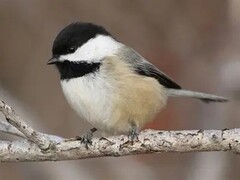
Black-capped Chickadee
Poecile atricapillus
The Black-capped Chickadee is one of the best birds for a beginning birder to learn. Small, active, and curious, it is easy to recognize once you know its basic markings and can be found throughout Wisconsin in every season.
Chickadees often stay busy in trees and shrubs, searching branches for food and calling back and forth to one another. Their familiar “chick-a-dee-dee-dee” call is often heard before the bird itself comes into view.
Because Black-capped Chickadees are common, approachable, and active year-round, they are excellent birds for practicing your observation skills.
Scientific name: Poecile atricapillus
How to Recognize a Black-capped Chickadee
The Black-capped Chickadee is a small, round-bodied bird with a relatively large head and short bill.
Look for three especially useful clues:
- a black cap on top of the head
- a black throat patch, often called a bib
- bright white cheeks between the black cap and bib
The back is mostly soft gray, while the wings and tail are darker gray with lighter edges. The sides of the body may have a pale buff or tan color.
Males and females look very similar, so beginners generally do not need to worry about telling them apart.
Instead of concentrating on every feather, first look for the combination of black cap, white cheeks, and black throat. Together, those markings make the Black-capped Chickadee fairly easy to recognize.
Size and Shape
Black-capped Chickadees are small birds, usually only about 5 inches long.
They have a compact, rounded appearance with:
- a large-looking head
- short neck
- small pointed bill
- moderately long tail
Their small size and quick movements are useful identification clues.
If you see a tiny bird repeatedly hopping among branches and inspecting twigs, leaves, and bark, take a closer look. It may be a chickadee.
Where to Look
Black-capped Chickadees are closely associated with trees and shrubs.
In Wisconsin, look for them in:
- deciduous and mixed forests
- woodland edges
- parks
- nature centers
- wooded trails
- neighborhoods with mature trees
- backyards with shrubs and feeders
They are especially common around forest edges where trees, shrubs, and open areas meet.
Chickadees frequently visit bird feeders, particularly during colder months. Black oil sunflower seeds and suet can attract them to yards.
When walking through a wooded area, listen for chickadees and watch the smaller branches. They often travel from tree to tree rather than staying in one location for long.
What It Sounds Like
Learning the Black-capped Chickadee by sound can make it much easier to find.
Its best-known call sounds like:
“chick-a-dee-dee-dee”
This familiar call is the source of the bird's name.
Chickadees also give a clear, whistled song that is often described as:
“fee-bee”
The song may sound surprisingly loud and clear for such a small bird.
When you hear a chickadee, stop and listen before trying to find it. Follow the direction of the sound and watch nearby branches for movement.
For beginners, this is a good bird for learning an important birding lesson:
Sometimes your ears will find the bird before your eyes do.
Behavior to Notice
Black-capped Chickadees rarely sit still for very long.
Watch for a bird that:
- hops quickly from branch to branch
- hangs from small twigs
- investigates leaves and bark
- briefly grabs food and moves away
- travels with other small birds
Chickadees sometimes hang upside down while searching for insects or seeds.
During fall and winter, they may join mixed flocks with nuthatches, woodpeckers, kinglets, and other small woodland birds.
If you find a group of chickadees moving through the trees, keep watching. Other species may be traveling with them.
That makes chickadees useful “detective clues.” Finding one species can help lead you to several others.
What Black-capped Chickadees Eat
Black-capped Chickadees eat both insects and plant foods.
Their diet can include:
- insects
- insect eggs and larvae
- spiders
- seeds
- berries
- other small plant foods
During warmer months, insects are especially important.
In winter, seeds become a more noticeable part of their diet.
At feeders, chickadees often take a sunflower seed and quickly fly to a nearby branch. Instead of eating at the feeder, they may hold the seed with their feet and open it elsewhere.
They also hide, or cache, food in different locations and return to it later.
When You Can See Them in Wisconsin
Black-capped Chickadees are year-round residents of Wisconsin.
That means beginners do not have to wait for migration season to find them.
Spring
Chickadees become more vocal as breeding season approaches. Their clear whistled songs are especially noticeable.
Summer
Look for adults moving through wooded areas searching for insects and caring for young birds.
Fall
Chickadees may begin forming small flocks and joining other woodland species.
Winter
They remain active even during very cold Wisconsin weather and are frequent visitors to backyard feeders.
Because they can be found year-round, chickadees are excellent birds for learning how bird behavior changes with the seasons.
Nesting and Family Life
Black-capped Chickadees usually nest in cavities.
They may use:
- natural holes in trees
- old woodpecker cavities
- softened or decaying wood
- properly designed nest boxes
The female builds the nest using materials such as moss, plant fibers, and soft animal hair.
After the young hatch, both parents work to bring food to the nest.
If you discover an active nest, observe it from a comfortable distance. Avoid approaching repeatedly or disturbing the adults.
Tips for Beginners
The Black-capped Chickadee is an excellent bird for practicing several basic identification skills.
Start with the face
Look for the combination of:
black cap + white cheek + black throat
You do not need to memorize every detail.
Watch how it moves
Chickadees are small, quick, and constantly investigating branches.
Behavior can sometimes identify the bird almost as quickly as color.
Listen for the name
When you hear “chick-a-dee-dee-dee,” stop and look around nearby trees.
Check nearby birds
If several chickadees are feeding together, look carefully around them. Nuthatches, woodpeckers, kinglets, and other small birds may be nearby.
Visit a feeder
A backyard feeder can be one of the easiest places to study chickadees at close range.
A Good Bird for Learning
The Black-capped Chickadee demonstrates what Birding Detective is all about.
You can use several clues together:
What does it look like?
Black cap, white cheeks, and black throat.
How big is it?
Small and compact.
How does it move?
Quickly through branches, sometimes hanging upside down.
What does it sound like?
“Chick-a-dee-dee-dee” or a clear whistled song.
Where is it?
Usually around trees, shrubs, woodland edges, parks, or feeders.
You do not need to rely on a single clue. Put several clues together, and the identification becomes much easier.
Look for the Black-capped Chickadee
The next time you visit a wooded trail, neighborhood park, nature center, or backyard feeder in Wisconsin, listen for the chickadee's familiar call.
When one appears, spend a few minutes watching instead of immediately moving on.
Notice where it lands. Watch how it searches a branch. Listen to its calls. Look at the black cap and bright white cheek.
A common bird can teach you a great deal when you take the time to notice the clues.
And once you know the Black-capped Chickadee well, you have one more familiar bird to help you solve the next birding mystery.