cooper's hawk
Listen to the Cooper's Hawk
Scientific Name: Astur cooperii
Family: Accipitridae (Hawks, Eagles, and Kites)
By Les Miller
introduction/overview
The Cooper's Hawk is a swift, agile bird of prey found in woodlands, parks, and neighborhoods throughout Wisconsin. Known for its long tail and rounded wings, this woodland hunter is particularly skilled at pursuing smaller birds through trees and shrubs. Once considered primarily a forest-dwelling species, Cooper's Hawks are now frequently seen in suburban areas, sometimes making dramatic appearances near backyard bird feeders. Their speed, sharp eyesight, and impressive maneuverability make them fascinating birds to observe.
How to Identify the Cooper's Hawk
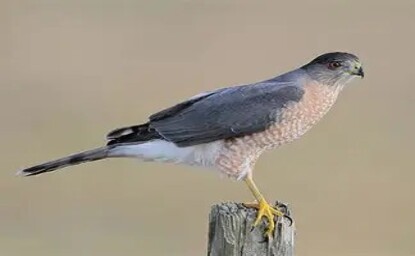
The Cooper's Hawk is a medium-sized woodland raptor with a relatively large head, short rounded wings, and a long tail. Adults have blue-gray upperparts, a dark cap, reddish-orange barring across the chest, and red eyes. Their long tails show dark bands and usually have a rounded tip. Juveniles are brown above with brown streaks running down their pale underparts and yellow eyes.
Cooper's Hawks generally measure about 14–20 inches long, with a wingspan of approximately 24–35 inches. Females are noticeably larger than males. They are often confused with Sharp-shinned Hawks, which are typically smaller and have proportionally smaller heads and more squared-off tails. Cooper's Hawks usually show a more prominent head and a rounded tail tip, although these differences can be difficult to judge in the field. Using several identification clues together is more reliable than relying on size alone.
Sounds and Behavior
Cooper's Hawks are generally quiet outside the breeding season, but they become more vocal when defending territories or communicating near their nests. Their most recognizable call is a rapid series of sharp, nasal notes, often described as “kek-kek-kek-kek.” They may also produce softer calls during courtship or when communicating with their young. In Wisconsin woodlands, these repeated calls can be an important clue to a Cooper's Hawk's presence.
Cooper's Hawks are remarkably agile hunters that specialize in capturing other birds. They often fly rapidly through trees, using quick wingbeats, sudden turns, and their long tails to maneuver around branches. They may also wait quietly on a concealed perch before launching a surprise attack. Around Wisconsin neighborhoods, a Cooper's Hawk may appear near backyard bird feeders, where concentrations of smaller birds provide hunting opportunities.
Habitat and Diet
Cooper's Hawks inhabit a variety of wooded environments throughout Wisconsin, including deciduous forests, mixed woodlands, forest edges, and wooded river corridors. They also adapt well to suburban neighborhoods, city parks, and residential areas with mature trees. These habitats provide sheltered nesting sites, concealed hunting perches, and open spaces where the hawks can pursue prey. Their ability to thrive near people has made Cooper's Hawks increasingly familiar visitors to Wisconsin backyards.
Cooper's Hawks feed primarily on medium-sized birds, including robins, doves, starlings, and jays. They occasionally capture small mammals such as chipmunks and squirrels. Using speed, surprise, and exceptional maneuverability, they often pursue prey through trees and dense vegetation. In Wisconsin neighborhoods, bird feeders can attract Cooper's Hawks because they concentrate potential prey in one area. Although their hunting may seem dramatic, these hawks play an important role in maintaining healthy wildlife populations.
When and Where to Find Cooper's Hawks in Wisconsin
Cooper's Hawks can be seen in Wisconsin year-round, though some migrate south in the fall while others remain through winter. Spring and fall migration provide additional opportunities to observe these swift woodland hunters. During winter, Cooper's Hawks may appear in neighborhoods and near backyard bird feeders where smaller birds gather. Early morning and late afternoon can be productive times to watch for hunting activity.
Birding Detective Tip: When looking for Cooper's Hawks, watch for sudden bursts of activity among smaller birds. A flock scattering quickly from trees or feeders may signal a nearby hawk. Scan nearby branches and watch for a long-tailed bird flying with several quick wingbeats followed by a short glide. Use binoculars and observe from a respectful distance, particularly around nesting sites.
Nesting and Family Life
Cooper's Hawks typically nest in mature deciduous, coniferous, or mixed forests, often choosing a sturdy fork in a tree or a large horizontal branch. The pair constructs a platform nest of sticks, lined with smaller twigs and pieces of bark. In Wisconsin, nesting activity generally begins in spring, and pairs may return to the same wooded territory year after year. They sometimes build a new nest near an older one rather than reusing the original structure.
Female Cooper's Hawks commonly lay three to five pale bluish-white eggs, sometimes marked with faint brown spots. Incubation lasts approximately 30–36 days and is performed mainly by the female. During this period, the male supplies food to his mate and helps defend the nesting territory. After hatching, the chicks remain in the nest while their parents provide food and protection.
Young Cooper's Hawks usually leave the nest about four to five weeks after hatching, although they are not yet fully independent. The fledglings remain near the nesting area while their parents continue feeding them and teaching them the skills needed to survive. As the young hawks develop stronger flight and hunting abilities, they gradually begin exploring farther from the nest. By late summer, many juveniles are becoming independent and preparing for their first fall migration or winter in Wisconsin.
Observing Cooper's Hawks in Wisconsin
Finding a Cooper's Hawk often requires patience and careful observation. Explore wooded trails, forest edges, and parks with mature trees, watching for a long-tailed hawk perched quietly among the branches. These agile hunters may suddenly appear as they pursue smaller birds through the trees. In Wisconsin neighborhoods, watch for quick movements near bird feeders or listen for alarm calls from songbirds that may reveal a hawk's presence.
When observing Cooper's Hawks, use binoculars and maintain a respectful distance. Avoid approaching active nests or disturbing adults caring for their young. If you encounter a hawk hunting near a backyard feeder, allow it to behave naturally rather than attempting to interfere. These predators are an important part of Wisconsin's ecosystem, and observing their behavior quietly can provide a fascinating glimpse into the relationships between birds and their habitats.
The Cooper's Hawk is a remarkable example of speed, agility, and adaptability in Wisconsin's birdlife. Whether you spot one gliding through a woodland clearing or making a surprise appearance in your backyard, each encounter offers a chance to appreciate the skills of this impressive bird of prey. Stay alert, watch the trees, and enjoy discovering the clues that make birdwatching an adventure.