Double-crested Cormorant
Listen to the Double-crested Cormorant
Scientific Name: Nannopterum auritum
Family: Phalacrocoracidae (Cormorants)
By Les Miller
About the Double-crested comorant
The Double-crested Cormorant is a distinctive waterbird commonly seen on Wisconsin's lakes, rivers, reservoirs, and Great Lakes shorelines. With its dark plumage, long neck, slender body, and hooked bill, this skilled underwater hunter is well adapted to catching fish.
One of the most recognizable behaviors of the Double-crested Cormorant is its habit of standing with its wings spread wide after swimming. You often see this posture on rocks, docks, logs, and exposed branches near the water.
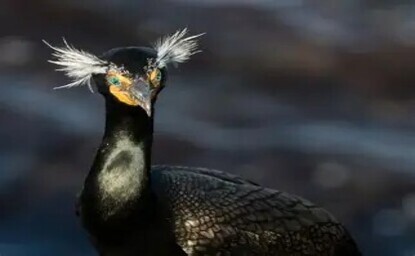
Despite its name, the Double-crested Cormorant does not always display visible crests. During the breeding season, adults may develop small tufts of feathers on either side of the head. These crests are usually absent or difficult to see during the rest of the year.
In Wisconsin, You can see Double-crested Cormorants along Lake Michigan, Green Bay, inland lakes, and major rivers. They are especially noticeable during the warmer months, when birds gather at feeding areas and breeding colonies.
Watching a Double-crested Cormorant dive beneath the surface, pursue fish underwater, and emerge to rest with its wings extended offers an excellent opportunity to appreciate the remarkable adaptations of Wisconsin's waterbirds.
how to identify
Adult Identification
The Double-crested Cormorant is a large, dark waterbird with a long neck, streamlined body, and a slender bill that curves into a small hook at the tip.
Breeding adults have mostly glossy black plumage, sometimes showing a greenish or bronze sheen in bright sunlight. Their bare throat pouch and facial skin are orange-yellow, creating a noticeable contrast with their dark feathers.
The eyes are a striking turquoise-green, although this feature is easiest to see at close range.
Breeding Crests
During the breeding season, adult Double-crested Cormorants may develop two small tufts of feathers on either side of the head.
These tufts give the species its name. They may be black or white, depending on the individual, and are usually visible only briefly during courtship.
Outside the breeding season, the crests disappear, so their absence does not rule out a Double-crested Cormorant.
Juvenile and Immature Birds
Young Double-crested Cormorants generally have browner plumage than adults.
Immature birds may show a pale brown or whitish throat, breast, or belly, creating considerable variation in appearance.
As they mature, their plumage gradually darkens and becomes more uniform.
Size and Shape
Double-crested Cormorants measure approximately 28 to 35 inches in length, with a wingspan of about 45 to 48 inches.
They have relatively short legs, large webbed feet, and a long tail that helps distinguish their silhouette from many ducks and other swimming birds.
When floating, they often sit low in the water, with much of the body submerged and the neck held upright.
Flight Identification
In flight, Double-crested Cormorants show a long neck, outstretched wings, and a relatively long tail.
Their silhouette can resemble a flying cross, especially when seen from below.
Cormorants often fly in loose lines or V-shaped formations, sometimes traveling close to the water.
Unlike many herons, which retract their necks into an S-shape during flight, cormorants fly with their necks extended.
Identification Tips
One of the easiest ways to recognize a Double-crested Cormorant is to watch for a dark waterbird perched with its wings spread wide.
Look for a hooked bill, long neck, orange-yellow throat patch, and low swimming posture.
When observing birds at a distance, watch their diving behavior. Double-crested Cormorants disappear completely beneath the water while pursuing fish, unlike many dabbling ducks that feed near the surface.
In Wisconsin, these identification clues are particularly useful along Lake Michigan, Green Bay, large inland lakes, and major rive
SOUNDS AND BEHAVIOR
Sounds and Vocalizations
Double-crested Cormorants are generally quiet away from their nesting colonies.
At breeding colonies, however, adults produce deep, guttural grunts, croaks, and rough calls. These sounds are most noticeable during courtship, territorial interactions, and activities around nesting sites.
Because cormorants are often silent while swimming or feeding, their appearance and behavior usually help identification more than their calls.
Underwater Hunting
Double-crested Cormorants are skilled underwater hunters that pursue fish beneath the surface.
Unlike diving birds that primarily propel themselves with their wings, cormorants use their powerful, webbed feet to move through the water. Their streamlined bodies and long necks help them maneuver while chasing prey.
They capture fish with their hooked bills and usually swallow them whole, often bringing larger fish to the surface before swallowing.
Wing-Drying Behavior
One of the most recognizable behaviors of the Double-crested Cormorant is its habit of perching with both wings spread wide.
After swimming or diving, cormorants often rest on rocks, logs, docks, or exposed branches with their wings open.
Their feathers are less water-repellent than those of many other waterbirds, allowing water to penetrate portions of their plumage. This can help reduce buoyancy while diving.
Spreading their wings helps dry their feathers and may also help regulate temperature.
Swimming and Diving
Double-crested Cormorants often swim with their bodies sitting low in the water and their long necks held upright.
When searching for fish, they may repeatedly disappear beneath the surface and emerge some distance away.
They can remain underwater for extended periods, although most feeding dives are relatively brief.
Birdwatchers can often recognize cormorants by watching their repeated diving movements and low swimming posture.
Social Behavior and Flocking
Double-crested Cormorants are social birds that frequently gather in groups.
They may feed together in productive fishing areas or rest on exposed rocks, docks, and shoreline structures.
During migration, they sometimes travel in long lines or V-shaped formations.
Large groups may gather at communal roosting locations, especially near lakes and major waterways.
Breeding Colony Behavior
During the nesting season, Double-crested Cormorants often gather in colonies containing dozens, hundreds, or even thousands of breeding pairs.
They may build nests in trees, on islands, or directly on the ground, depending on local habitat conditions.
Adults communicate through low grunts, croaks, and other guttural calls, particularly around nesting areas.
Both parents help care for the young and defend their nesting sites.
Behavior to Watch for in Wisconsin
Along Lake Michigan, Green Bay, and Wisconsin's larger inland lakes, watch for Double-crested Cormorants diving for fish or resting with their wings spread wide.
During spring and fall migration, look for groups flying over lakes and rivers or gathering near productive feeding areas.
Their unusual diving technique, distinctive wing-drying posture, and social behavior make Double-crested Cormorants especially interesting birds to observe in Wisconsin.
Habitat and Diet
Preferred Habitat
Double-crested Cormorants inhabit lakes, rivers, reservoirs, and coastal waters where fish are plentiful.
In Wisconsin, they are commonly found along Lake Michigan, Green Bay, Lake Superior, and larger inland lakes. They also use major river systems, including the Mississippi River.
They prefer open water with nearby places to rest, such as rocks, docks, exposed branches, and islands. During the breeding season, they often gather in colonies on protected islands or wooded shorelines.
Diet
Fish make up nearly all of the Double-crested Cormorant's diet.
These adaptable hunters eat a variety of fish depending on what is available locally. Their prey may include minnows, shiners, perch, and other small freshwater fish.
Cormorants capture fish underwater using their hooked bills and powerful webbed feet. They generally swallow their prey whole.
Feeding Habits
Double-crested Cormorants are pursuit divers, meaning they actively chase fish beneath the surface rather than waiting for prey to approach.
They may hunt alone or gather in groups where fish are abundant.
After feeding, cormorants often rest on rocks, logs, or shoreline structures with their wings spread wide to help dry their feathers.
Wisconsin Birding Notes
Look for feeding cormorants along the Great Lakes shorelines, around harbors, and on larger inland lakes.
Repeated underwater dives, low swimming posture, and groups resting on exposed structures are useful clues when identifying these birds.
Cormorants may also appear on smaller lakes and rivers during spring and fall migration.
Seasonal Information and Birding Locations
Spring (March–May)
Double-crested Cormorants begin returning to Wisconsin as lakes and rivers open after winter. Migration becomes increasingly noticeable during April and May.
Look for cormorants flying over open water, swimming near shorelines, or resting on rocks and exposed branches. Many return to established nesting areas during this season.
Summer (June–August)
Summer is an excellent time to observe Double-crested Cormorants in Wisconsin.
Breeding birds can be found along the Great Lakes and at suitable inland nesting locations. Adults frequently travel between nesting colonies and feeding areas.
Watch for their distinctive diving behavior and familiar wings-spread posture while resting.
Fall (September–November)
During fall migration, Double-crested Cormorants gather along major waterways and large lakes before heading south.
Groups may be seen flying in lines or loose V-shaped formations, especially near Lake Michigan, Green Bay, and the Mississippi River.
Numbers generally decrease as colder weather arrives and inland waters begin freezing.
Winter (December–February)
Double-crested Cormorants are uncommon in Wisconsin during winter.
Most migrate south to areas where open water and fish remain available. Occasionally, individual birds may remain near ice-free portions of large lakes or rivers.
Where to Look in Wisconsin
Lake Michigan and Green Bay: Look around harbors, breakwaters, bays, and rocky shorelines. Cormorants often rest on exposed structures or dive in nearby waters.
Lake Superior: Search sheltered bays, harbors, and open coastal waters during the warmer months.
Lake Winnebago: This large inland lake provides feeding and resting opportunities, particularly during migration and the breeding season.
Mississippi River: Look for cormorants along open stretches of river, near islands, and around shoreline resting sites.
Larger Inland Lakes and Reservoirs: Scan open water for diving birds and watch for individuals perched on docks, logs, or exposed rocks.
Wisconsin Birding Tip
Bring binoculars and scan open water for dark birds swimming low in the water.
Cormorants often disappear completely beneath the surface while pursuing fish, then emerge some distance away.
Their distinctive habit of spreading their wings while resting makes them especially easy to recognize from shore.
Nesting and Family Life,
Breeding Season
Double-crested Cormorants generally breed during spring and summer in Wisconsin.
They are colonial nesters, often gathering in groups ranging from a few pairs to thousands of breeding birds. Nesting colonies are commonly established on islands, protected shorelines, and in trees near productive fishing waters.
Nest Construction
Both parents participate in nest building. Nests are constructed from sticks, twigs, and other available vegetation.
Depending on the location, nests may be placed in trees, on rocky islands, or directly on the ground.
Some nesting sites are used repeatedly over many years, with returning birds repairing existing nests or building new ones.
Eggs and Incubation
Females typically lay three to four pale blue eggs, although clutch sizes may vary.
Both parents incubate the eggs for approximately 25–28 days.
Raising the Young
Cormorant chicks hatch relatively helpless, with little or no down, and depend on their parents for warmth, protection, and food.
Both adults feed their chicks by regurgitating fish.
As they grow, young cormorants develop darker feathers and become increasingly active around the nest.
They generally begin flying at about six to seven weeks of age, although they may continue receiving food from their parents afterward.
Colony Life
Cormorant nesting colonies can be busy and noisy places.
Adults frequently communicate through deep grunts and croaking calls, especially when defending nests or interacting with nearby birds.
Large colonies may also affect surrounding vegetation because accumulated droppings can damage trees and other plants.
Wisconsin Birding Notes
Double-crested Cormorants nest at suitable locations along Wisconsin's Great Lakes shorelines and on some inland islands.
When observing nesting colonies, maintain a respectful distance. Approaching too closely may disturb adults or expose eggs and chicks to predators and harsh weather.
Binoculars or a spotting scope allow birdwatchers to enjoy colony activity without disturbing the birds.