hairy woodpecker
Listen to the Hairy Woodpecker
Scientific Name: Leuconotopicus villosus
Family: Picidae (Woodpeckers)
By Les Miller
introduction/overview
The Hairy Woodpecker is a familiar year-round resident of Wisconsin's forests, wooded parks, and mature neighborhoods. With its striking black-and-white plumage, strong bill, and energetic movements along tree trunks, this woodpecker is an exciting bird to discover in any season.
At first glance, the Hairy Woodpecker looks remarkably similar to the smaller Downy Woodpecker. However, its larger size, noticeably longer bill, and preference for substantial tree trunks provide valuable identification clues. Learning to recognize these differences is a rewarding step toward becoming a more confident Wisconsin birder.
How to Identify a Hairy Woodpecker
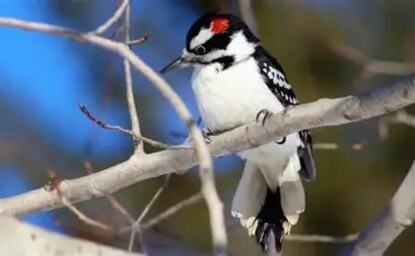
The Hairy Woodpecker is a medium-sized woodpecker measuring approximately 7 to 10 inches long. It has a bold black-and-white pattern, a bright white stripe running down the center of its back, and black wings marked with white spots. Its long, sturdy bill is an important identification feature.
Males have a small red patch on the back of the head, while females lack this marking. Both sexes have a relatively long bill, often nearly as long as the head itself.
The easiest way to distinguish a Hairy Woodpecker from a Downy Woodpecker is to compare their bills and overall size. The Hairy Woodpecker is noticeably larger and has a longer, stronger bill. It also typically favors larger tree trunks and substantial branches when searching for food.
Sounds and Behavior
Hairy Woodpeckers communicate through sharp, high-pitched calls, rapid rattling sounds, and drumming. Their common call is a short, piercing peek! that can carry through the woods. They also produce a descending series of notes that sounds like a quick, rolling rattle.
Rather than singing like a robin or cardinal, Hairy Woodpeckers drum on trees and other resonant surfaces to communicate and establish territories. Their drumming is generally faster than that of the smaller Downy Woodpecker and is especially noticeable during spring.
Hairy Woodpeckers are strong climbers that move along tree trunks and large branches, bracing themselves with stiff tail feathers. They use their powerful bills to probe and chip into bark and wood while searching for insects. In Wisconsin's woodlands, you may hear their tapping before you spot them.
Habitat and Diet
Hairy Woodpeckers are found throughout Wisconsin in mature deciduous, coniferous, and mixed forests. They favor areas with large trees, standing dead wood, and fallen logs that provide abundant feeding opportunities. They also visit wooded parks, nature preserves, and residential neighborhoods with established trees.
Their diet consists primarily of insects and their larvae, especially wood-boring beetles, ants, and caterpillars. Using their strong bills, Hairy Woodpeckers chip into bark and decaying wood to uncover insects hidden beneath the surface. Their long, specialized tongues help them reach prey deep inside narrow crevices.
During fall and winter, Hairy Woodpeckers supplement their insect diet with seeds, nuts, and berries. They occasionally visit backyard feeders, particularly those offering suet or sunflower seeds. Leaving dead trees standing where safe can provide valuable feeding habitat for these year-round Wisconsin residents.
When and Where to Find Hairy Woodpeckers in Wisconsin
Hairy Woodpeckers are permanent residents throughout Wisconsin, making them possible to see during every season. They inhabit forests, wooded parks, nature preserves, and neighborhoods with mature trees. Unlike many songbirds, they do not migrate south for the winter.
Spring is an especially rewarding time to look for Hairy Woodpeckers. As breeding season approaches, their drumming and calls become more frequent, making them easier to locate. During summer, adults can be seen searching for insects and carrying food to their young. In fall and winter, look for them climbing large tree trunks and investigating dead or decaying wood.
Good places to search include wooded trails, forest edges, and parks with mature hardwoods or conifers. In northern Wisconsin, look in mixed forests with standing dead trees. In southern Wisconsin, wooded nature preserves, oak forests, and established residential areas can also provide excellent viewing opportunities. Listen for sharp calls or tapping sounds, then scan nearby trunks and larger branches for movement.
Nesting and Family Life
Hairy Woodpeckers begin their breeding activities in Wisconsin during spring. Rather than building traditional nests of twigs and grasses, a male and female excavate a nesting cavity in a dead tree or a decaying section of a living tree. The entrance is typically a round opening that leads to a deeper chamber where the eggs and young are protected.
The female usually lays three to six white eggs directly on wood chips at the bottom of the cavity. Both parents share incubation duties for approximately 11 to 15 days. After hatching, the young remain inside the nest for about four weeks while their parents bring them insects and other food.
Once the young leave the nest, the adults continue feeding and caring for them for a short period as they learn to climb trees and find food independently. Abandoned woodpecker nesting cavities can later provide valuable shelter for other birds and small woodland animals, making Hairy Woodpeckers important contributors to Wisconsin's forest habitats.
Attracting Hairy Woodpeckers to Your Backyard
Hairy Woodpeckers may visit Wisconsin backyards, especially those with mature trees, nearby woodlands, and natural feeding areas. Although they are generally less frequent feeder visitors than Downy Woodpeckers, providing suitable food and habitat can increase your chances of attracting them.
Suet feeders are an excellent choice, particularly during Wisconsin's cold winter months. Hairy Woodpeckers may also eat black oil sunflower seeds and shelled peanuts. Position sturdy feeders near trees where the birds can perch and retreat to safety. Keep feeders clean and replace spoiled food regularly.
Maintaining mature trees and preserving standing dead wood, where it is safe to do so, provides natural feeding and nesting opportunities. Avoid unnecessary pesticide use, since insects are an important part of the Hairy Woodpecker's diet. A backyard with healthy trees, natural vegetation, and a dependable food source can become a welcoming stop for these striking woodland birds.