Red-bellied Woodpecker
Listen to the Red-bellied Woodpecker
Listen to the Red-bellied Woodpecker
Scientific Name: Melanerpes carolinus
Family: Picidae (Woodpeckers)
By Les Miller
introduction/overview
The Red-bellied Woodpecker is a striking year-round resident of Wisconsin's woodlands, parks, and neighborhoods with mature trees. Its bold black-and-white barred back, bright red head markings, and distinctive calls make it one of the state's most recognizable woodpeckers.
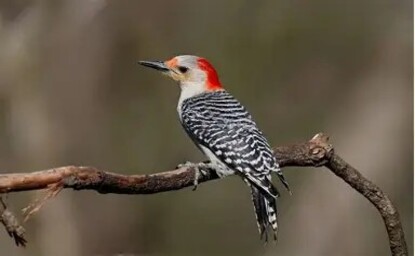
Despite its name, the Red-bellied Woodpecker does not have a bright red belly. Instead, it has a faint reddish wash on its lower abdomen that can be difficult to see in the field. Its red head markings are much more noticeable and often provide the first clue to its identity.
These energetic birds spend much of their time climbing tree trunks, searching for insects, and calling from the treetops. They also visit backyard feeders, giving Wisconsin birdwatchers opportunities to observe their fascinating behavior year-round.
How to Identify a Red-bellied Woodpecker
The Red-bellied Woodpecker is a medium-sized woodpecker measuring approximately 9 to 10½ inches long. Its most distinctive features are a black-and-white barred back, pale grayish face and underparts, and bright red markings on the head and neck. The faint reddish wash on its belly is often difficult to see.
Male Red-bellied Woodpeckers have red feathers extending from the bill over the crown to the back of the neck. Females have red on the back of the neck and near the base of the bill, but the center of the crown is gray. These differences can help birdwatchers distinguish males from females.
Despite their similar names, Red-bellied and Red-headed Woodpeckers look quite different. The Red-headed Woodpecker has an entirely red head, a sharply contrasting black back, and large white wing patches. The Red-bellied Woodpecker has a striped back and red coloring concentrated along the crown and nape rather than covering the entire head.
Sounds and Behavior
Red-bellied Woodpeckers are among Wisconsin's more vocal woodland birds. Their most familiar call is a loud, rolling churr or churr-churr, often heard echoing through wooded neighborhoods and forests. They also make shorter, sharp calls when communicating with other woodpeckers or responding to disturbances.
Like other woodpeckers, Red-bellied Woodpeckers drum rapidly on resonant tree trunks and branches to announce their presence and establish territories. Drumming becomes especially noticeable during late winter and spring as breeding activity increases.
These active birds climb tree trunks and large branches while searching for food, often pausing to investigate bark crevices. They can also move along smaller branches and occasionally catch insects in flight. Red-bellied Woodpeckers store food in cracks and crevices and sometimes return later to retrieve hidden seeds, nuts, or other food items.
Habitat and Diet
Red-bellied Woodpeckers occur in Wisconsin's deciduous and mixed forests, especially in areas with mature oak, maple, and other hardwood trees. They also thrive in wooded parks, forest edges, orchards, and residential neighborhoods with established trees. They are especially common in southern Wisconsin but can also be found farther north.
These woodpeckers have a varied diet that includes beetles, ants, caterpillars, and other insects, along with acorns, nuts, seeds, berries, and fruits. They search for insects along tree trunks and branches, using their strong bills to investigate bark and crevices. Unlike some woodpeckers that rely heavily on insects, Red-bellied Woodpeckers eat substantial amounts of plant material year-round.
During Wisconsin's colder months, Red-bellied Woodpeckers continue searching for insects while also relying on stored food, nuts, and seeds. They frequently visit backyard feeders offering suet, shelled peanuts, and sunflower seeds. Their habit of hiding food in tree crevices helps them prepare for periods when natural food becomes harder to find.
When and Where to Find Red-bellied Woodpeckers in Wisconsin
Red-bellied Woodpeckers are year-round residents in much of Wisconsin, especially in the southern and central parts of the state. Their range has expanded northward over time, and they can now be found in suitable wooded habitats across a growing portion of northern Wisconsin.
Spring is an excellent time to find these birds. Their loud, rolling calls and rapid drumming become more frequent as they establish territories and prepare to nest. During summer, look for adults climbing tree trunks, searching for insects, and carrying food to their young. In fall, they gather acorns, nuts, and seeds, sometimes storing them in tree crevices for later use.
Winter offers another opportunity to observe Red-bellied Woodpeckers. With leaves gone, their black-and-white barred backs and red head markings are often easier to spot. Look for them in mature hardwood forests, wooded parks, and neighborhoods with established trees. In southern Wisconsin, oak woodlands and river corridors are particularly promising places to search. Listen for their distinctive calls, then scan nearby trunks and larger branches for movement.
Nesting and Family Life
Red-bellied Woodpeckers begin nesting in Wisconsin in spring, usually from April to May. Rather than building nests of twigs and grasses, they excavate cavities in dead trees or decaying sections of living trees. Both the male and female help prepare the nesting cavity, which provides a protected space for their eggs and young.
The female typically lays four to five white eggs on wood chips at the bottom of the cavity. Both parents take turns incubating the eggs for approximately 12 to 14 days. After hatching, the young remain inside the nesting cavity for about three to four weeks while their parents bring them insects and other food.
Once the young leave the nest, the adults continue caring for them as they learn to climb trees and search for food independently. Red-bellied Woodpeckers generally raise one brood per year in Wisconsin. Their abandoned nesting cavities can later provide shelter and nesting places for other birds and small woodland animals, making these woodpeckers valuable members of the forest ecosystem.
Attracting Red-bellied Woodpeckers to Your Backyard
Red-bellied Woodpeckers frequently visit Wisconsin backyards, especially those with mature trees, wooded surroundings, and reliable food sources. Their bright red head markings and bold black-and-white barred backs make them especially enjoyable to watch at feeders year-round.
Offering suet, shelled peanuts, and black oil sunflower seeds can help attract Red-bellied Woodpeckers. They may also visit feeders containing nut pieces or other suitable foods. Sturdy suet cages, platform feeders, and large hopper feeders provide convenient feeding locations. Place feeders near trees or shrubs where birds can retreat if disturbed, and keep them clean to help prevent disease.
A bird-friendly backyard offers more than food. Mature hardwood trees, native shrubs, and standing dead trees—where they can be safely retained—provide natural feeding, shelter, and nesting opportunities. Reducing pesticide use helps protect the insects these woodpeckers depend on. With suitable habitat and dependable food sources, Wisconsin homeowners may enjoy visits from Red-bellied Woodpeckers year-round.