Virginia Rail
Listen to the Virginia Rail
Scientific Name: Rallus limicola
Family: Rallidae (Rails, Gallinules, and Coots)
By Les Miller
introduction/overview
The Virginia Rail (Rallus limicola) is a secretive marsh bird that inhabits Wisconsin's freshwater wetlands during the warmer months. Often hidden among dense cattails, sedges, and rushes, this slender bird is more frequently heard than seen. Its long, slightly curved reddish bill, rusty-colored breast, and distinctive grunting calls make it a fascinating species for birders exploring Wisconsin's marshes. With patience and careful listening, visitors may discover this elusive bird moving quietly through shallow water and wetland vegetation.
How to Identify the Virginia Rail
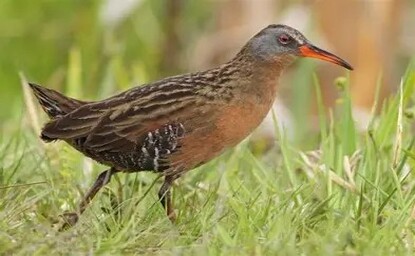
The Virginia Rail is a secretive marsh bird measuring approximately 8–11 inches long. It has a slender, laterally compressed body that allows it to slip between dense cattails and reeds. Its most distinctive features include a long, slightly downward-curved reddish bill, a gray face, and rich rusty-brown coloring across the breast and neck.
Its back is streaked with dark brown and black, while its sides show bold black-and-white barring. The short tail is often held slightly upright, revealing white feathers underneath. Long toes help the Virginia Rail move through shallow water and soft marsh vegetation.
Virginia Rails are sometimes confused with Soras, another secretive Wisconsin marsh bird. The Virginia Rail has a longer, reddish bill and a rusty breast, while the Sora has a shorter, yellow bill and grayer underparts. Because Virginia Rails spend much of their time hidden among wetland plants, their distinctive calls are often the first clue that one is nearby.
Sounds and Behavior
The Virginia Rail is often heard long before it is seen. One of its most recognizable calls is a series of loud, grunting notes commonly described as sounding like “kid-ick, kid-ick.” It also produces rapid, repeated ticking calls and softer grunts, especially during the spring breeding season.
Virginia Rails move quietly through dense cattails, sedges, and rushes, using their narrow bodies to slip between closely packed stems. They usually remain hidden, but occasionally step into small openings along marsh edges to search for food. When threatened, they generally prefer to run into thick vegetation rather than fly.
In Wisconsin, spring and early summer are particularly good times to listen for Virginia Rails. Visit a freshwater marsh during the early morning or evening, pause along an established trail or boardwalk, and listen carefully. Their unusual calls may reveal a bird concealed just a few feet away.
Habitat and Diet
Virginia Rails inhabit freshwater marshes, shallow wetlands, and wet meadows throughout Wisconsin. They favor areas with dense cattails, sedges, rushes, and other emergent plants, especially where shallow water and muddy ground provide shelter and food.
Their diet consists mainly of small aquatic animals, including insects, snails, worms, spiders, and crustaceans. They also eat seeds and other plant material. Using their long, slightly curved bills, Virginia Rails probe soft mud and shallow water to locate food hidden beneath the surface.
In Wisconsin, look for suitable habitat along marsh edges, shallow pools, and wetland boardwalks. Virginia Rails often remain concealed within vegetation, but careful observers may occasionally spot one walking along an open muddy edge. Listening for their calls is usually the most effective way to find them.
When and Where to Find Virginia Rails in Wisconsin
Virginia Rails are migratory marsh birds that generally return to Wisconsin in April and May. They breed in freshwater wetlands throughout the state during spring and summer, with most departing for warmer areas by September or October. Spring and early summer are especially good times to detect them because calling birds are more easily heard.
Horicon Marsh National Wildlife Refuge is one of Wisconsin's best-known locations for finding Virginia Rails. Other promising areas include Cherokee Marsh in Dane County, Crex Meadows Wildlife Area in Burnett County, and freshwater marshes around the Lake Winnebago region. Search for wetlands with dense cattails, sedges, and shallow water, where these secretive birds can move through protective vegetation.
Early morning and evening are excellent times to listen for their distinctive grunting and ticking calls. Walk slowly along established wetland trails or boardwalks, stopping frequently to listen. Although Virginia Rails are difficult to see, patient birders sometimes spot one crossing a narrow opening between cattails or feeding along a muddy marsh edge.
Nesting and Family Life
Virginia Rails build their nests in Wisconsin's freshwater marshes, usually hiding them among dense cattails, sedges, and rushes. They build shallow, cup-shaped nests from dead marsh vegetation and place them on or just above wet ground or shallow water. Surrounding plants help conceal the nests from predators.
During the breeding season, females typically lay 5 to 13 buff-colored eggs marked with brown spots. Both parents share incubation duties for approximately three weeks. The chicks hatch covered in black down and can leave the nest soon after hatching, although they continue to depend on their parents for warmth, protection, and food during their early development.
Virginia Rail families are rarely seen because they remain well hidden within thick marsh vegetation. Birders should avoid approaching nesting areas or entering dense wetlands to look for chicks. Observing quietly from established trails or boardwalks gives these secretive birds the space they need to raise their young.
Observing Virginia Rails in Wisconsin
Observing a Virginia Rail requires patience, careful listening, and a willingness to spend time in Wisconsin's freshwater marshes. These elusive birds spend much of their lives hidden among cattails and sedges, where their narrow bodies allow them to move through thick vegetation. Their distinctive grunting and ticking calls often provide the first clue that one is nearby.
When exploring wetlands, watch for small openings between cattails, muddy shorelines, and shallow pools where a Virginia Rail might briefly step into view. Binoculars can help you recognize its long reddish bill, rusty breast, and black-and-white barred sides. Remaining still and observing quietly often provides a better opportunity than attempting to follow a bird through dense vegetation.
Early mornings and evenings during spring and early summer are especially rewarding times to listen for Virginia Rails. Stay on established trails or boardwalks, avoid disturbing nesting habitat, and allow the birds to move naturally. Even a brief glimpse of this secretive marsh bird can be a memorable highlight of a Wisconsin birding outing.